A recent article (in French) from Belgian news site "L'Express" summarises a growing acceptance in the scientific community that India is the cradle of humanity as we know it. Prof. Tejraj M. Aminabhavi, winner of the Nikkei Asia 2013 prize, summarises the various contributions that have been fundamental to the evolution of humanity. Briefly,
Maths: India is where Zero, Infinity and Pi (Indian mathematician to first estimate pi correctly using infinite series known today as the Leibniz series) where discovered, it also set the basis for algebra, arithmetic, trigonometry, and many other concepts crucial to modern technology.
Medicine: Ayurveda is the most ancient medical practice in the world, it's ancient text detail advanced notions in Anatomy, Embryology, Physiology, Genetics, Psychology, as well as information on the Immune system, the digestive apparatus and metabolism. Furthermore, Sushruta is the first surgeon to operate with anaesthetics
Metaphysics & Astronomy: Did you think gravity was discovered by Isaac Newton? I did, that is what I was thought at school, at college, and everywhere really... well not quite, it was known to the Indians 1000 years earlier, mathematician Brahmagupta noted that "Bodies fall towards the earth as it is in the nature of the earth to
attract bodies, just as it is in the nature of water to flow." The Earth's circumference, that it revolves around the Sun, the origin of the Universe as well as some modern Cosmological theories for the Universe... the list just goes on.
Astronomical tables for stellar movements across the skies may have already been computed 4500 years before they where discovered by western astronomers. Indian Astronomy has many first to its name, something hard to believe today.
Languages: India is not only the repository of the first languages spoken by mankind, but it gave the world many of its modern language concepts.
And much more... from religion (4 major world religions come from India, possibly even Jesus Christ may have got his teaching from India. Yoga, Meditation, modern concept of Consciousness.
India was the largest economy in the World for over a 1000 years before its colonisation and eventual cultural and economic destruction by Britain.
There once was a land, today known as India, source of knowledge, source of growth and development, power-house of economic strength and beacon of light for humanity. This fact is no longer a question. So today we can only ask, What if she awakens again from her slumber? Imagine what India's revival could gift the world? A world torn by strife, hunger, war, and divided and in need to enlightenment.
India Awaken! Indian Awaken! India Awaken!
Friday, 31 January 2014
Thursday, 30 January 2014
Stop Acid Attacks on Women
Stop Acid Attacks.org is fighting to raise more awareness for this horrendous crime on women. Shame on our society to raise and harbour such coward men.Spot of Shame is a yearly campaign to remember women that have succumbed to such attacks. Here are the next events in various towns and cities across India:
Delhi: Khan Market, 22 Jan 2014
Mumbai: Bandra Station, 25 Jan 2014
Kanpur: Nawabganj, 27 Jan 2014
Unnao: 28 Jan 2014
Lucknow: 29 jan
Chennai: 30 Jan (At Eliot's beach, Besant Nagar, opposite Barista coffee shop).
Agara : 01 Feb
Panipat : 03 Feb.
Meerut : 05 Feb.
Saturday, 16 November 2013
Summarising Sustainability
A short and sweet summary of what Sustainability means. Of course, the triple bottom-line is just a story continuing from where this leaves us at...
Labels:
society
Sunday, 20 October 2013
India among top ten countries where slavery is prevalent
Slave labour has been officially outlawed worldwide for over a century in many countries and more recently in the last decade a number of western and African nations have made official apologies for their role in the salve trade. However, it is estimated that close to 30 million people worldwide are still living under various forms of modern salve labour.
A recent article in The Indian Express ranks India in 4th category worldwide where salvery is still prevalent. It is interesting to note that India is considered to have one of the best anti-slavery laws in the world, but due to poor enforcement of the laws, the practice prevails. India has also the dubious record of the highest bondage-labour in the world, with half of the world's salve labour population being in India. The salient points highlighted by the article are:
* With an estimated 13.9 million slaves, India is home to almost half the world's slave population.
* Almost all forms of slavery are prevalent, ranging from inter-generational bonded labor to sex trafficking, child labor and forced marriage.
* Experts say India has excellent anti-slavery laws but enforcement is sporadic and inconsistent. It remains one of the few nations not to have ratified the Worst Forms of Child Lab our Convention.
Labels:
economic,
globalisation,
politics,
society
Wednesday, 11 September 2013
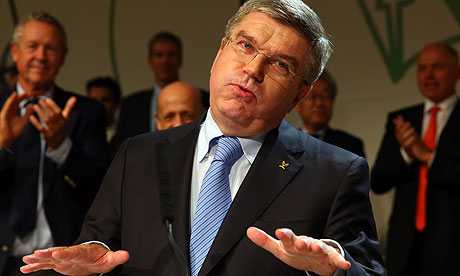
New Olympic Chief wants Unity in Diversity
Wonderful to hear the news of the new head of the IOC (International Olympic Committee) which oversees the games worldwide. German Thomas Bach said, and I quote:
I want to lead the IOC according to my motto – unity in diversity.Human consciousness on the rise?
Labels:
culture,
education,
social,
sustainable growth
International Conference on Business Social Partnership
Syllogic Consultants participated at the 2nd International Conference on Business Social Partnership organised by the ISOL foundation that promote spiritual values in businesses. The conference was held from 7-9th September at the Delhi University and saw a range of topics discussed.
We presented a paper on enabling sustainable business practices in Indian SMEs, which was warmly received by the participants as most of the topics concentrated on corporate businesses rather than small enterprises. We were further felicitated for our on-the-ground work in making a real impact towards achieving sustainable development in rural communities. You may review our presentation below.
We also submitted a research paper on our work which will be published in the conference proceedings.
We presented a paper on enabling sustainable business practices in Indian SMEs, which was warmly received by the participants as most of the topics concentrated on corporate businesses rather than small enterprises. We were further felicitated for our on-the-ground work in making a real impact towards achieving sustainable development in rural communities. You may review our presentation below.
We also submitted a research paper on our work which will be published in the conference proceedings.
Labels:
corporate,
social,
society,
sustainable growth
Beautiful Delhi Flora
I was recently in the capital to attend a conference on the value-based management practices inspired from India's spiritual heritage. I came to the city with a certain apprehension based on the many media stories surrounding the recent attacks on women as well as a sense of shame from its leaders who are not able to take a firm stance in the face of these most horrific events. Delhi, a city of rapist, Delhi a city of misogynist, Delhi capital of all that is shameful and ugly in the Indian man. So it was with a pleasant and refreshing outlook that I discovered a city that is much more than what the recent media has painted it to be. From its most efficient and luxurious metro service, to its colourful fauna and its love of arts, I found Delhi to be a grand old-lady that is striving to rejuvenate itself.
![]() |
| Yesteryear Ambassador parked on the road side. |
| I Touch a face and it murders me |
On my last day, the conference ending early, I whiled my spare time with a visit to the Delhi Art Galley in Haus Kaas, coming across one of its artist on display, Amitava, I was startled by a canvas painted back in 1989 which expressed with distinct clarity the essence of the feeling of violence that Delhi inflicts on its women. The painting was titled "I Touch A Face And Suddenly It Murders Me".
![]() |
| Artist are no different to scientist, they too seek to describe the world, only the language differs. |
![]() |
| People actually queue in the crowded metro stations, a first in India! |
![]() |
| It is surprising the number of peddle rickshaws that ply the small streets of the older city |
![]() |
| An other pleasant surprise is the introduction of electric shared autos |
![]() |
| Always a lemon juice vendor on the crowsded street corners |
Labels:
art-n-culture,
social,
society
Subscribe to:
Posts (Atom)